Commercial buildings rely on glass for daylight and visual openness, yet that same transparency often works against privacy, branding, and comfort. Two film categories dominate the market for solving this tension: one way vision film, which is perforated and printable, and frosted window film, which relies on a translucent surface texture rather than tiny holes. Both reduce direct sightlines, but they do it through completely different physical mechanisms, and that difference determines which spaces they suit.
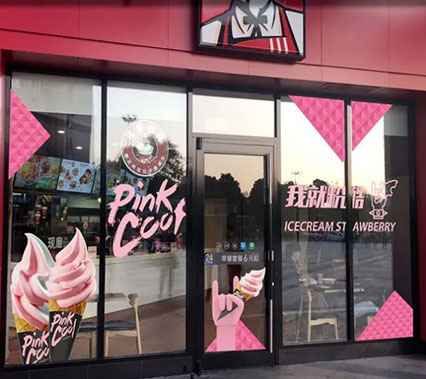
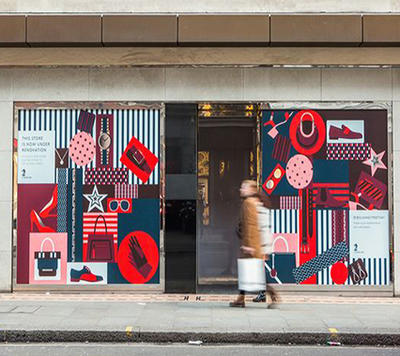
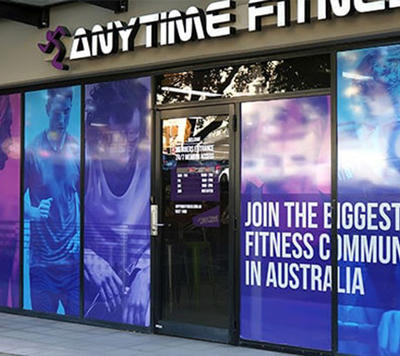
Storefronts that want a printed graphic visible from the street but still want staff inside to see approaching customers usually lean toward perforated film. Conference rooms, restroom partitions, and glass office walls that only need a soft, even diffusion of light without any imagery typically lean toward frosted film. The rest of this guide breaks down the mechanics, performance differences, and selection criteria so the decision is based on measurable factors rather than guesswork.
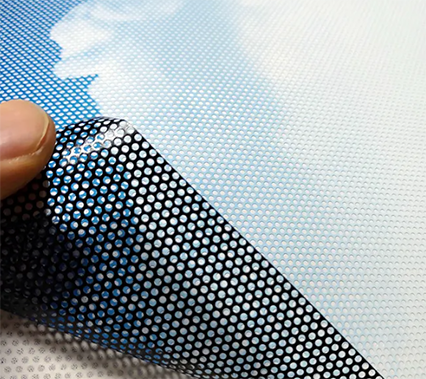
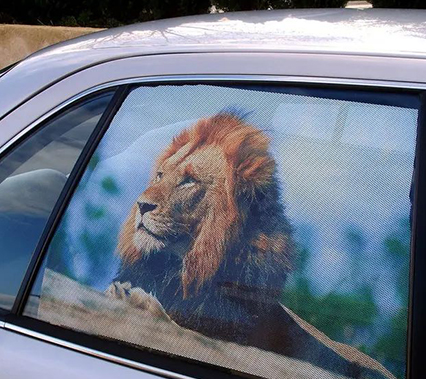
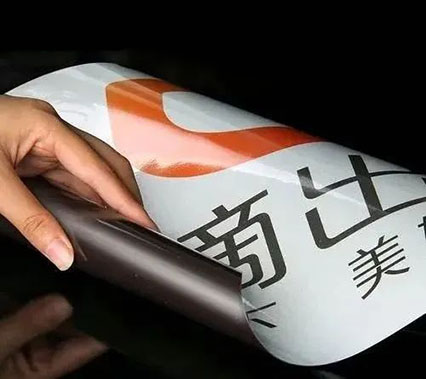
One way vision film is built from a solid-colored vinyl sheet that has been mechanically punched with a grid of small round holes, typically covering between 50 and 70 percent of the surface area depending on the grade. The remaining solid material carries the printed graphic or solid color, while the holes allow light and limited vision to pass through from the darker side to the brighter side.
This creates an asymmetry that depends entirely on lighting conditions rather than the film itself:
Frosted film works on an entirely different principle. Instead of holes, it uses a micro-textured or etched surface that scatters light in many directions. There is no directional asymmetry between day and night because the scattering effect is constant regardless of which side is brighter. This is why frosted film reads as a uniform, soft haze from both sides at all hours, while perforated film behaves like a one-way mirror that shifts with ambient light.
The table below summarizes how each option performs across the criteria that matter most for commercial glass decisions.
| Factor | One Way Vision Film | Frosted Window Film |
|---|---|---|
| Outward visibility | Retained through perforations, strong during daylight | None; view is diffused in both directions |
| Printed graphics | Full-color printing supported on the solid surface | Solid tone or etched pattern only, no photo-quality printing |
| Day vs night performance | Effect weakens or reverses after dark | Consistent at all hours |
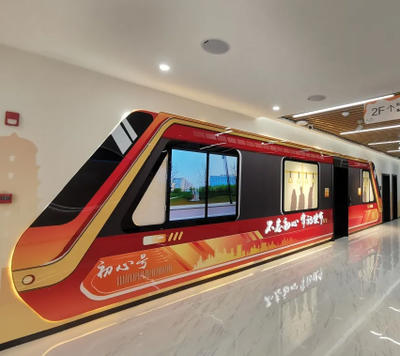
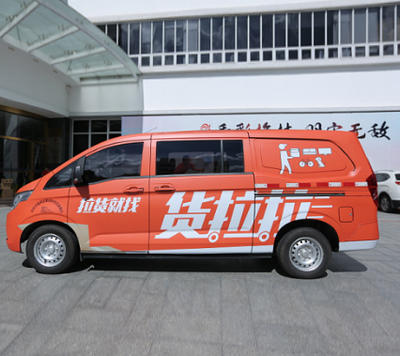
| Best use case | Branded storefront glass, vehicle windows, bus shelters | Office partitions, restroom glass, meeting rooms |
| Light transmission | Moderate, reduced by hole coverage ratio | High diffuse transmission, low direct glare |
| Installation surface | Applied to exterior-facing side for correct viewing angle | Can be applied to either side with similar results |
| Typical lifespan | 3 to 7 years depending on grade and UV exposure | 5 to 10 years, less prone to print fading |
| Cleaning | Requires care around perforation edges to avoid lifting | Standard glass cleaning with soft cloth |
Choosing between the two usually comes down to answering three questions: does the glass need to carry a graphic, does staff or occupants need to see outward, and does the effect need to hold consistently after dark.
Rule of thumb: if the glass is meant to communicate a brand message to the street while keeping an outward view for people inside during business hours, perforated film is the better fit. If the goal is purely to soften or block a view without any imagery, frosted film is simpler and more consistent.
Within the one-way vision category, film is generally sold in two performance tiers. Understanding the practical differences helps match the grade to the expected lifespan of the installation rather than overspending or underspending.
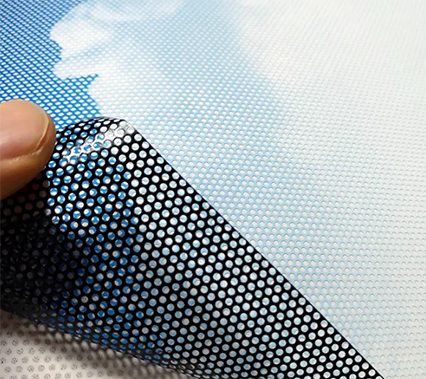
Finer perforation pattern for sharper printed detail, higher-grade adhesive for long-term exterior exposure, and stronger fade resistance under continuous sun. Suited to flagship storefronts and installations expected to stay in place for several years.
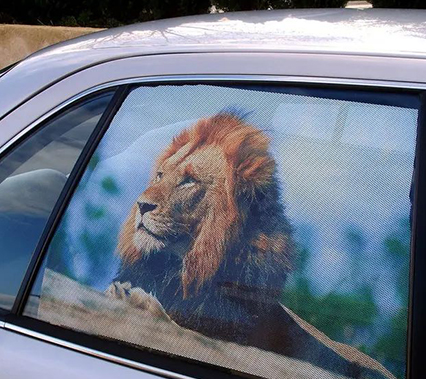
A cost-conscious option for short-term campaigns, seasonal promotions, or temporary storefront changes. Perforation quality and print sharpness are slightly reduced compared to the premium grade, but performance remains adequate for shorter display cycles.
| Specification | Premium Grade | Economical Grade |
|---|---|---|
| Recommended display duration | 2 to 5 years | 3 months to 1 year |
| Perforation consistency | Uniform, tighter tolerance | Standard tolerance |
| Print sharpness at distance | High, suited to detailed imagery | Moderate, best for bold text or simple graphics |
| Adhesive grade | Weather-resistant, exterior rated | Standard indoor or short-term outdoor |
An economical practical one way vision film remains a reasonable choice for pop-up retail, real estate window signage, or event-based promotions where the graphic will be replaced within a year regardless of material durability.
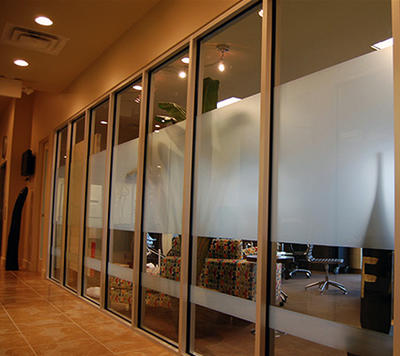
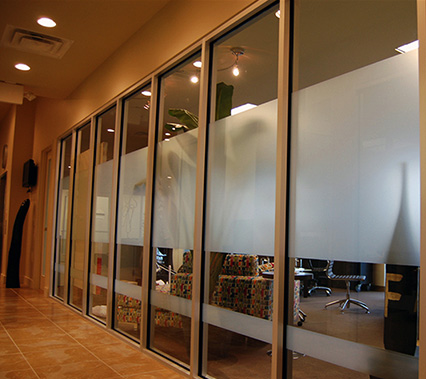
While retail glass gets most of the attention, both film types extend into a wider range of settings. The image below shows a standard window film application on interior glass, illustrating the softer, even diffusion typical of frosted treatments.
| Setting | Recommended Film | Reason |
|---|---|---|
| Retail storefront glass | One way vision | Printable branding with retained outward view |
| Office glass partition | Frosted film | Consistent privacy without needing a graphic |
| Bus shelter or transit panel | One way vision | Advertising surface with passenger visibility |
| Bathroom or shower glass wall panel | Frosted film | Even privacy regardless of interior lighting |
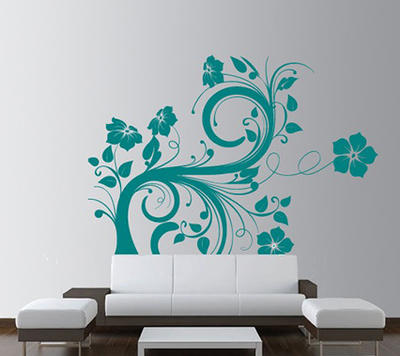
| Small decorative surfaces such as vinyl on glass cups | Frosted or printed vinyl | Decorative rather than functional privacy need |
Frosted-style treatments have also become common in residential contexts, including peel and stick shower door film and lightweight adhesive coverings styled after traditional japanese windows, where the goal is a soft diffused look rather than a printed message.
Both film types are surface-applied and do not require replacing the glass itself, but they differ slightly in handling.
No. The effect depends on the brighter side being on the outside. Once interior lighting exceeds exterior brightness after dark, the directional privacy weakens unless additional blinds or lower interior lighting are used.
Frosted film typically supports solid tones, etched patterns, or simple cut designs rather than full-color photographic printing, since its texture is what creates the diffusion effect rather than a printed layer.
Frosted film generally holds up longer in constant direct sunlight since there is no printed ink layer to fade. Premium-grade perforated film narrows this gap with UV-resistant inks and adhesives.
It can work for shorter campaigns of a few months to about a year, but for multi-year installations a premium grade is generally more cost-effective due to slower fading and stronger adhesive performance.
Both film types can generally be applied to mildly curved surfaces with careful heat-assisted installation, though highly complex curves may require a professional installer to avoid visible stretching or wrinkling.
COPYRIGHT ©2018 Shanghai Hanker Industrial Co., Ltd., ALL RIGHTS RESERVED.

 English
 简体中文
简体中文